

Svara Yoga in brief:
When we use the word "svara," we are talking about something more than just the air flowing from the nostrils — we are also talking about the flow of prana, a very subtle and vital aspect of breath. In reality, breathing is a process that is generally overlooked, even though it is one of the most important functions of the body.
Breath is a person's most precious treasure, for without it one cannot survive more than three minutes. There is a saying that a person is born alone and dies alone, but this is not correct. A person is born with breath, with that subtle prana which is the essence of breath. Breath is the companion of the human "soul." This is why the Upanishads refer to svara as atmaswaroop or brahmaswaroop, implying that the human being is part of Brahma, universal consciousness. If you can realize the true reality of the breath, you can realize the atma.
Breathing, then, is something more than a simple, physical act. Every breath carries a hidden meaning and a specific "encoded message." For the spiritual aspirant, breath is the means to the ultimate goal. In svara yoga, breath is a process that can be manipulated and controlled.
alternate breathing
It may seem that breathing occurs through both nostrils at once, but this is not the case. If you analyze your breathing, you will discover that usually one nostril remains open for a period of time, and the breath flows and passes only through that side. Later that nostril closes, and the other one opens.
What does this mean? Physiologically, it means this must have a particular effect on the nervous system, producing a specific kind of stimulus. It must also have a specific effect on the brain, which requires very systematic regulation. Svara yoga is the science that reveals this previously unknown process.
Svara yoga explains how the flow of svara changes at regular intervals; this is not random at all. Roughly every hour, or every hour and twenty minutes, the active nostril changes. This rhythm regulates all psychological and physiological processes. If the svara is irregular, it is a clear sign that something in the body is not functioning properly.
The three svaras
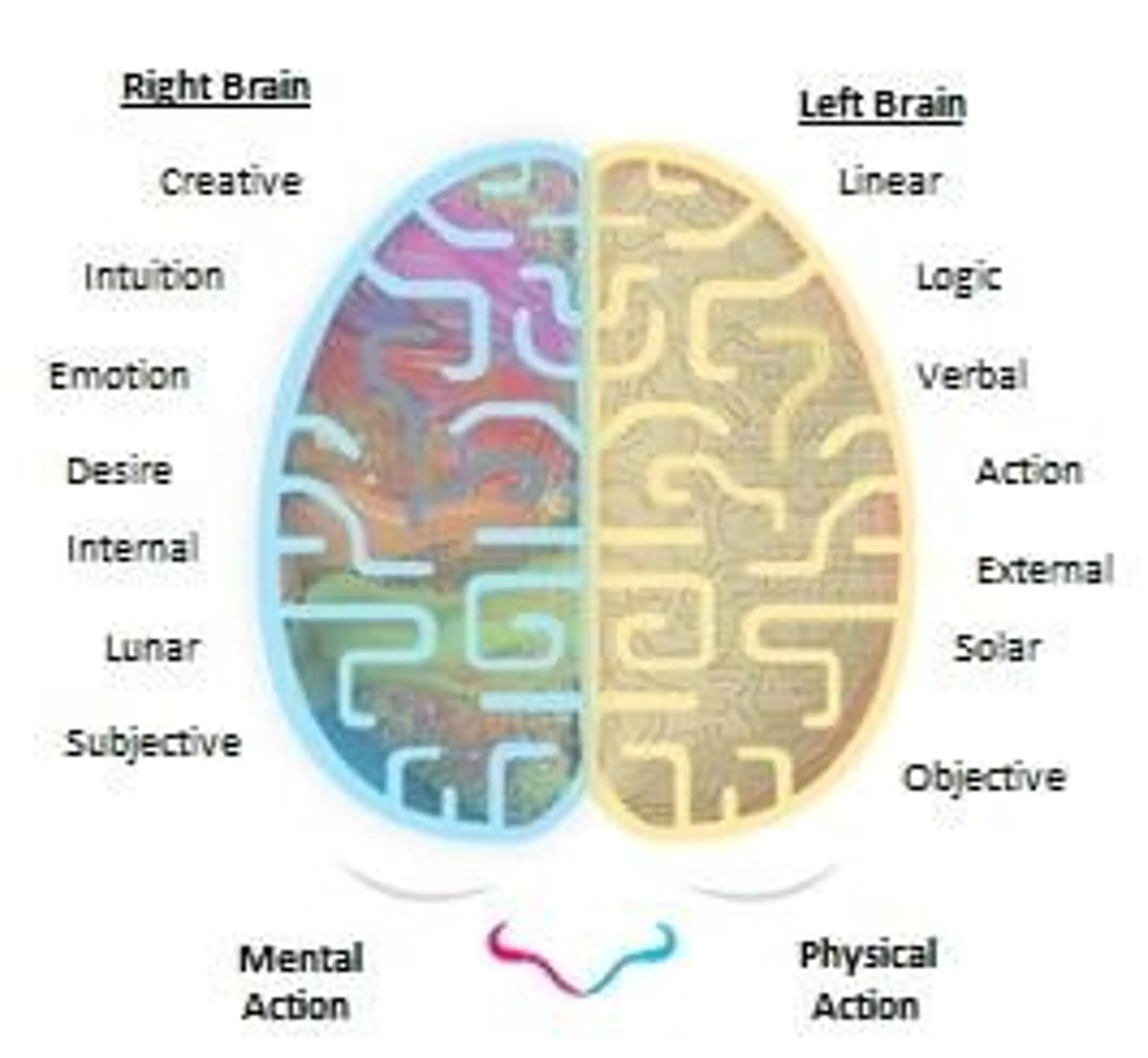
One svara flows through the left nostril, another through the right, and a third through both nostrils together. The rhythm of the breath is based on the body's biorhythms, its energetic rhythms, and it also relates to the two hemispheres of the brain.
In the human body, the three svaras correspond to three main systems, which can be called the Trinity. Mind is one aspect, vital force another, and spirit or soul the third. Mind, vital force, and spirit joined together make up the human being. In svara yoga, the mind is known as chitta, the vital force is prana, and the spirit is known as atma. Chitta governs the sensory nerves — the eyes, nose, tongue, ears, and skin. Prana governs the five organs of action: speech, hands, feet, and the reproductive and excretory organs. And atma is the overall witness, or controller. When the left nostril is flowing, it means that mental energy, chitta, is dominant, while pranic energy is weak.
When the right nostril is flowing, the pranic forces are stronger and the mental aspect is weak. When both nostrils are active together, it means that spiritual energy, the power of atma, holds sway.
Action in relation to svara
When you meditate, pray, or contemplate, that is spiritual action. When you walk, talk, urinate, or eat, that is physical action. When digestion is taking place and enzymes are flowing through the body, that too is called physical action. But when you are worried, or have many thoughts running through your mind, or when you are remembering or planning, that is mental action. Whether you feel compassion or anger, all of this is mental action. If the right nostril is open during meditation, you will experience physical difficulty. The body will be restless.
If the left nostril is open, the mind will wander. However, when both nostrils are open, the mind becomes focused. Then you can easily become absorbed in the process of meditation.
Ida, pingala, and sushumna
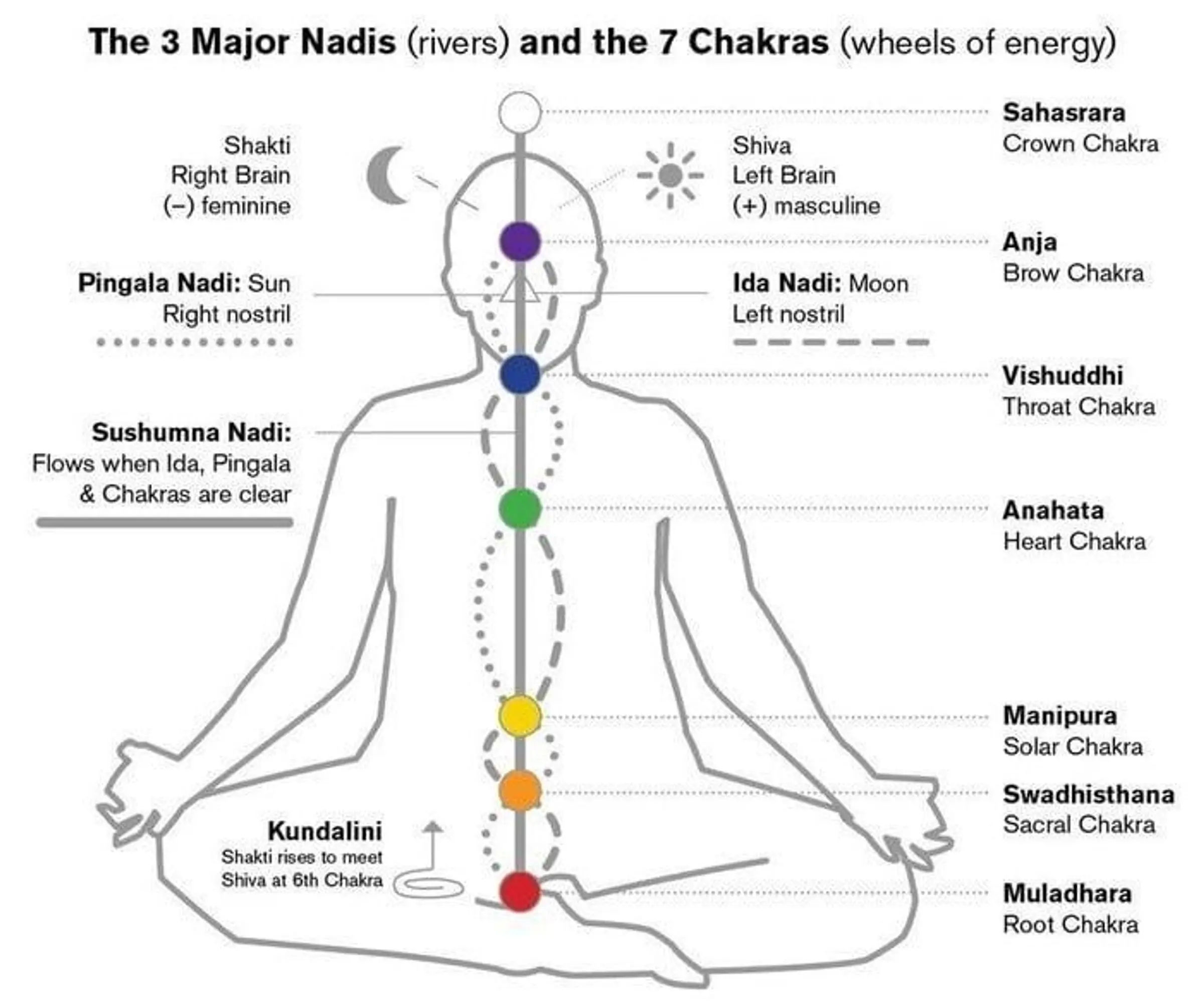
We have spoken about the flow of breath that creates a flow of energy in the body. In yoga, this flow is called a nadi. These are known as ida, pingala, and sushumna. The left nostril is connected to the ida nadi network, the right to pingala, and when both nostrils function together, the main channel, or sushumna network, is activated.
The energy flows produced by the left and right svara act much like the positive and negative currents in an electrical circuit. The left svara is the negative line — cooling, feminine, lunar energy — while the right is positive — warming, masculine, solar energy.
Sushumna runs straight through the center of the spine and joins with ida and pingala slightly above the bridge of the nose, at the ajna chakra, the point behind the center of the eyebrows. It is through sushumna that kundalini shakti, a spiritual force of great power, must be directed. When both nostrils are active, it means the sushumna channel is open.
When sushumna flows, the mental and physical energy patterns become even and rhythmic, thoughts are stilled, and the mind is calm. This is why it is also known as shunya svara. Shunya means emptiness. For the yogi, this is the most important kind of svara, because it aids in the practice of dhyana.
Breath reaches deeper than the lungs
It is written in the svara shastra that personal, detailed knowledge of svara can only be obtained from a guru. But the shastras do offer some guidance. They say that svara is prana, the vital force. It is the means by which prana shakti is transmitted throughout the body. That is why it influences not only the gross plane of existence — it is of the greatest importance on the subtle and spiritual planes.
The Mundaka Upanishad compares svara to a bowstring, upon which consciousness can be raised in order to pierce the atman, the spirit of the universe. In this way, breathing not only sustains the physical body but is also a direct medium for the evolution of consciousness.
Piyush Mittal, Nirmala.pl Institute of Yoga and Ayurveda
Source: Swara Yoga: The Tantric Science of Brain Breathing
Swami Muktibodhananda Saraswati
Enjoyed this article?
Share this knowledge with your family or friends.
Deepen your practice
Related courses in this area of knowledge.
Piyush Mittal
· Founder of the InstituteTeacher of Integral Yoga, expert in traditional Ayurveda, and practitioner of Marma point therapy. For years he has combined authentic, source knowledge from India with a modern understanding of health and human development.


