

In the fifth edition of our ONE-YEAR PROFESSIONAL COURSE — HOLISTIC THERAPIST FOR BODY AND MIND, one of the participants, Przemysław Waszak, wrote a beautiful diploma thesis that I would like to share with everyone. It is an ambitious, deeply researched piece of work. I suspect it may be the first thesis on Svara Yoga ever written in Poland. — Piyush Mittal
During Christmas Eve dinner, my sister-in-law asked me what exactly this Svara Yoga is. Although I can answer that question in a single sentence, that sentence — much like the sutra “yoga chitta vritti nirodha” — demands an extensive commentary. Commentary is essential if we are to grasp the meaning hidden between the words. The trouble with words that try to bring us closer to the meaning of the thing they describe applies to everything language can express. If I were asked what an atomic bomb is, would I really be able to say anything meaningful about it? I could, of course, read hundreds of pages about that bomb, but until I find myself at the epicenter of the blast, I will never truly know what an atomic bomb really is. Perhaps the atomic metaphor is too forceful. So let me set it aside in favor of something more familiar to us: keys — the kind we all carry with us every day.
The Key
A key has a shape, a size, a color, and a texture — all easy enough to describe. Unfortunately, a key tells us nothing about what it opens. A key is merely a tool for opening cupboards, the secrets tucked away in grandmother's dresser, or doors that lead us toward new adventures. Why do I reach for the metaphor of a key? Because a key is something achingly familiar to us, everyday to the point of tedium, plain and thoroughly unremarkable. Much like the practice of Svara Yoga, or the breath itself — or rather, the constant observation of it: being with it on the inhale, being with it on the exhale, being in the pauses, being in between.
I do not write these words from the vantage point of someone who has already toured the whole landscape of Svara Yoga. Quite the opposite — I am only at its very edge, at the beginning, or at least that is how I feel every single day. The first thought that arrives when I surface into waking life from deep sleep, or from a dream-filled one, is the breath. During waking hours I stay with the breath as often as I possibly can, and the last thought before sinking into sleep is also the breath — or more precisely, the svara. Svara is the sound, the vibration of air flowing through the nostril, and the knowledge of it is preserved in the Shiva Svarodaya, the source text whose exact dating is lost somewhere in the depths of time. Yet the exact date hardly matters. Does knowing when a key was forged help us open the door? No — what counts is the space of experience that this key helps us gain access to.
It is telling that for the ancient Hindus, the flow of air through the nostrils mattered so much that they gave it its very own word — svara! They also gave a separate word to the change in that flow — udaya. Hence the name of the source text, Shiva Svarodaya.
Back in Time
Before I go further, a few words on how Svara Yoga first entered my life, instantly helping to quiet the turbulent reality of my younger years. On how it then vanished for long years, only to resurface from the ocean once more, like a new continent offering space and the chance of a new life.
The beginning of this story, in this incarnation, dates back to the second half of the 1990s, when my mind was occupied with a very different view of Energy and the mysteries of the universe than it is now. When my classes on magnets, semiconductors, and the strange mathematical-physical worlds came to an end, I would board a bus or a train whose sole purpose was to deliver me to my evening classes in music theory and double bass. On the way from the train and bus station to the music school, it was impossible to walk past a shop with the charming name “Pod Gwiazdami” (“Under the Stars”). That shop still exists today, and inside you can find every kind of esoteric product imaginable — and, of course, books. Two of the ones I bought back then were “The Power of Life” and the equally concise and fascinating volume, “Chakras,” by Harish Johari. It was “The Power of Life” that first introduced me to Svara Yoga.
Looking back on that period of my life, it was not a blissful or idyllic time, but rather a turbulent, chaotic one, dark and tamasic by nature. And yet, roughly halfway through it, I was granted the grace of encountering the literature of Svara Yoga and its healing power. That encounter was like being stripped of the fear of the evil lurking in the dark valley. Like the voice of my guardian angel crying out a warning of cliffs looming ahead. It was an important moment in my life, though I don't recall approaching Svara Yoga back then in the organized, consistent way I do now. It was more a matter of groping in the dark for lifebuoys whose existence I could only sense intuitively. I jumped from topic to topic, trying this and that without any real plan.
And yet even that modest taste of this teaching helped me deal with my most tormenting problems, cleanse body and mind, and step into new challenges with greater courage and hope of success. I finished the labor camp known as high school, went to university, and right after graduating moved abroad in search of work and income. As you might imagine, that was not an esoteric period of my life. There was no room in it for studying the mind and consciousness — only for securing a livelihood on foreign soil. Svara Yoga fell into oblivion for a good twenty-odd years. And yet, curiously, out of all the upheavals of those years, the moves and other situations in which one tends to lose one's belongings rather than gain any — out of my entire esoteric library, only two books survived: “The Power of Life” and “Chakras” by Harish Johari!
My next encounter with Svara Yoga came during the one-year professional course “Holistic Therapist for Body and Mind,” which I attended in 2023/2024 at the Institute of Yoga and Ayurveda in Wrocław. That was when I decided to refresh my knowledge and make it the subject of my diploma thesis — to approach the topic systematically and with great enthusiasm. After all, if Svara Yoga had helped me once before, it should work in much the same way now.
The Evaporation of Duality — Kung Fu
Looking back on ten months of continuous observation of the breath and the svaras, I feel comfortable and confident enough now to describe the first steps into the land of Svara Yoga. When I sat down to write my diploma thesis on the subject and tried to find a name for that first period of practice, I settled on the word Observation. Because that is exactly what I did for the first five months. Simple observation of the breath: right, left, right, and left again, right for three and a half hours, left for two and a half hours, right for four hours, left for ninety minutes, and round and round it went — from morning until evening. And yet what was actually happening in that period was not mere observation. That is how it looked from the outside, but the process unfolding somewhere in the depths was far more significant and far more interesting. When I finally grasped it, its weight — and, at the very same time, its simplicity — left me stunned. Something so utterly obvious that only practice and lived experience can release it from Aladdin's lamp.
What was happening resembled a droplet of water losing its separateness as it dissolves into a vast ocean. The dissolving of the duality of some “I” that practices “something,” some technique. A total sinking into the breath, one that was not accompanied by any spiritual raptures whatsoever. No sacred sweat or sense of accomplishment like the kind that comes from long practice of asana sequences, no noticeable surge of energy like with pranayama, no dissolving into space and time like in meditation. None of that. Just ordinary breathing, the everyday inhale and exhale, tedium, repetition, work on an assembly line — and yet, a great transformation: the evaporation of duality and its final disappearance. The cries and sobs of the terrified droplet of water, pleading to keep its separateness, fell silent. And all that remained was a great stillness and peace, for the path had opened to all the information contained within the ocean — the stories the ocean tells itself. The land of Svara Yoga revealed itself, along with the now-visible horizon of my journey, already within my reach.
That period of observation, and the rather tedious business of noting through which nostril the air happens to be flowing, reminds me of a film from my childhood. The hero — a young boy who keeps getting beaten and bullied — goes looking for a karate teacher, hoping the master will help him find confidence and kick the bullies' backsides. He finds an elderly man tending his bonsai trees — a master who does not teach him any karate moves at all. Quite the opposite: to his astonishment, the master orders him to paint a fence, chop wood, and carry buckets of water. Well… perhaps not all of these tasks at once in that particular film, but it is, after all, a recurring motif in karate films about people striving to overcome their own weaknesses.
And yet, when the protagonist of that film, unable to bear these seemingly pointless tasks any longer, flies into a rage, the master reveals to him the true essence of the exercises he has been performing. He shows him that certain trained movements sink so deeply into the body's memory and the subconscious that the boy is able, without a moment's thought, to defend himself. It is already within him; it has become part of his nature, reflexes he no longer needs to think about, and which help him stand up to whatever life throws at him. He became what he had practiced. In the same way, I stopped simply practicing Svara Yoga — I quite simply became Svara Yoga, and it became me.
This is the step a svara yogi takes right at the outset — dismantling the duality between the self and the practice being performed. Svara Yoga is demanding, very difficult for a person of our times, driven as we are by impatience and a conviction that the world will simply bow before us. One must dissolve into Svara Yoga, surrender to it entirely, reshape one's life and adapt it to its practice. Right from the start, one must let go of the “I” that practices “something.” One must merge with that something and trust in the profoundly transformative power of the simple observation of the breath.
Now picture a martial arts training hall. Picture a blind master — blind, without eyes. Picture an equally “blind” newcomer, though this one has a perfectly functioning pair of eyes. One is physically blind, yet his awareness pervades everything. The other sees with his eyes, but does not yet understand what he is even doing there. As you might expect, the second one takes quite a beating, while the master lays out for him the truth about kung fu, saying:
“If you ever go back to the West, how will you explain to your people these strange words: kung fu? Will you call it a martial art? A way of summoning the spirits of the crane and the tiger? Kung fu means great skill, the fruit of hard work. A great poet can attain kung fu, so can a great painter or calligrapher. They can rightly be called masters of their art. Even a cook, a farmhand with a broom, or the perfect servant can attain it. Training, preparation, and ceaseless practice, until you feel the powerlessness of body and mind, until you are too exhausted even to sweat or draw a breath. That is the way — the only way — to attain kung fu.”
Svara Yoga is not quite so exhausting, though it is undoubtedly contained within the essence of those words. It is chopping wood and carrying buckets of water. It is washing dishes and hanging out the laundry, before enlightenment and after enlightenment. It is something that, from the outside, looks entirely ordinary — it is the inhale and the exhale — yet from within, it looks utterly different. It has a quality that cannot be seen, only felt… like the scent of realization. That is exactly what Svara Yoga is.
That blind master utters one more line: “In kung fu, we say that one hand lies while the other speaks the truth.” It is not so in Svara Yoga. Both nostrils speak a part of the truth. The right nostril speaks with the voice of the Sun, of masculinity and fire. The left nostril speaks with the voice of the Moon, of femininity and water.
Breath — Two Worlds
An essential step in setting out on the path of Svara Yoga is understanding the following words, which are, in effect, engraved on the very key that opens the gates of this story. They read as follows:
Every person born and raised in the West, in trying to understand their own nature, is confronted with the effort of assembling a complete picture of the world from the fragments handed to us by the Western scientific method. That method, by its very nature, can only divide, sequence, and describe slices of reality, all the while insisting that from this shattered glass some sensible picture of the world can still be pieced together. It is an approach with enormous limitations of its own, and we can see the effects of this way of looking at humanity and the cosmos especially now, as the method runs out of air. It is choking, drowning, unable to grasp the phenomenon of human consciousness — not to mention that within this Nature, which scientists consider mindless, its rationality and its cosmic plan, its cosmic consciousness, are practically staring us in the face.
There is nothing strange in this. At the very foundation of Western science lies the banishment of subjective, human experience. Galileo was the first to exile our subjectivity beyond the walls of science. Later giants of science, such as Newton and his followers, carried on that tradition — although Newton himself actually held a remarkably broad view and took an interest in things that today's scientists would rather find embarrassing. Still, it is very hard to free ourselves from the legacy of the founding fathers of the scientific method. It is likewise hard to tell Descartes that he was wrong. No fairy tales in the style of “I think, therefore I am.” Rather, “I think, therefore I think,” or “I am, therefore I am.” That comes closer to a truth that only reveals itself when, in meditation, we invite the components of our subtle body to a game of chess and remain, ourselves, only the Observer.
So then, what truth does Western science tell us about the human being? It tells us that the human body is made up of separate systems: nervous, circulatory, respiratory, excretory, and so on. And the system that interests me, the respiratory system, is treated as nothing more than a little machine for gas exchange. And of course, yes — that is indeed one of its functions, but not the only one. It is not widely known that the nostrils are connected to both branches of the Autonomic Nervous System (ANS): the sympathetic nervous system, which is more active when air flows through the right nostril, and the parasympathetic nervous system, which is more active when air flows through the left nostril. Going further, all the nerves of the ANS are connected to the “inner machinery of the organism, forming a kind of net around every cell, fiber, tissue, bone, and so on, so that the organism can be aware both of its surroundings and of itself” (1). And most importantly, the nostrils are connected to the brain — to the cerebral cortex and its twin hemispheres, which coordinate the workings of the entire organism — and the nose is an instrument for shifting cortical activity, and therefore has an influence on the mind and on consciousness. I don't recall ever being taught such a holistic model of the human being and its organism in any natural science class.
By placing an equals sign between breath and mind, we can instantly grasp the essence of Svara Yoga. Mind and consciousness are abstract concepts, perceived as something difficult to control, or whose control lies entirely beyond our reach. Breath, on the other hand, is a physiological reality. And so control over the mind and consciousness can begin with the simple observation and regulation of the breath.
Allow me here to treat the above in a somewhat mathematical fashion, placing into the equation two sentences that represent two different pictures of the world. The first represents the Western way of thinking, the second the Eastern:
If we simply agree to set an equals sign between breath and mind, along with its expressions — thoughts, emotions, and action — then we can finally modify the Western way of thinking and arrive at this sentence: Thoughts, emotions, and deeds are breath in action. And so, through the breath, we can govern our mind and its expressions in both the physical body and the subtle body. And this is the essence not only of Svara Yoga, but of the whole of Yoga. Yoga is a complete and comprehensive scientific method — in the Eastern sense, one that takes the human being and human experience as something worthy of observation and study. This stance stands in obvious opposition to the approach of Western civilization, which treats the human being as a little machine cut off from nature and from the laws of the cosmos.
The difference between Svara Yoga and other breathing techniques — pranayama, for instance — lies in the fact that the latter concerns itself with controlling the breath by exercising the capacities of our physical body: control of the inhalation (puraka), the retention (kumbhaka), and the exhalation (rechaka) of air from the lungs. Svara Yoga, on the other hand, “is not a method of controlling the breath, but a way of using ordinary breathing in order to harmonize the life force — prana — with the breathing pattern. This technique rests on one basic fact that is often overlooked and ignored in everyday life: that we normally breathe freely through only one nostril at a time. This alternating breath shifts roughly once an hour.” (2)
Svara Yoga helps to shift our emotional states and our thinking simply by changing which nostril is active. It also brings about long-lasting, deep changes in personality, drawing on what is known as the one-hour cycle, which I will describe in a moment. This cycle is the very foundation of the practice. And it was precisely this one-hour nasal cycle that interested me most at the very outset of my journey through the land of Svara Yoga.
The One-Hour Cycle
The one-hour cycle is the cyclical shift of airflow from one nostril to the other over the course of roughly an hour. The source text Shiva Svarodaya speaks precisely of this cycle — no more, no less than one hour per nostril. In scientific articles on nasal cycles, however, one finds an entire zoo of different cycles. According to the authors of these studies, in normal, healthy people the airflow through the nostrils shifts anywhere from 15 minutes up to 10.5 hours. There are two fundamental problems with these findings. The first concerns not so much the number of people studied as the duration of the studies themselves, which usually last only 24 hours. The second follows from the first, and forces us to ask whether we can even speak of cyclicity at all when studying a phenomenon over such a short span of time.
My own observation of the airflow through my nostrils, now spanning ten months, has shown that no other cycle exists besides the one described in the source text thousands of years ago. Any departure from that rhythm causes the activity of our nervous system to shift unevenly, acyclically. And — as I will describe in more detail further on — our subtle bodies become dependent on external conditions, rather than functioning as they do when our sympathetic and parasympathetic nervous systems work in equal intervals. The nasal cycles described in the scientific literature are the product of averaging, not something real; they rest on the assumption that whatever is measured over 24 hours will reflect the following days and months of our lives, regardless of the season, the weather, or the varying circumstances of life. This is a mistaken assumption, unsupported by any long-term observation — nothing more than a mathematical trick of computing an average value.
The second problem is a claim often repeated in the scientific literature: that a normal, healthy person has a nasal cycle ranging anywhere from two to six, or even eight, hours. Setting aside the fact that such cycles do not actually exist, let me try to describe what long, sustained breathing through just one nostril might mean. Personally, I believe that airflow through one nostril lasting around three hours, with occasional longer stretches here and there, is nothing to worry about, and works perfectly well within the daily life of a modern person. Life, after all, largely consists of action, movement, and directing our energy outward in order to secure our livelihood and our material well-being. The problem arises when our lives lack moments of true rest — activities that bring us pure pleasure, that recharge our batteries, moments for meditation, for simply doing nothing at all.
Let us imagine that before work we go to the gym, or even practice a vigorous style of yoga. In our body, the sympathetic system dominates, since our activity is purely exertive. Then we get into the car, sit in the morning traffic jam, and head to work. The sympathetic system keeps working, responsible for our focus on what is happening on the road, out there in the external world. Once at work, we typically interact with a huge number of different tasks, other people, and problems to solve. In trying to cope with all this, we must stay alert to the outside world — think logically, and in many cases wrestle with our own anger, frustration, and dissatisfaction that reality is not shaping up the way we would like. As before, our sympathetic system is at work. Lunchtime arrives, an hour's break from work. And what do we do? We gather with other people and start moving our mouths — paying hardly any attention to the meal itself, but instead getting caught up in conversations about work, politics, TV shows, and loans. I hardly need to say which part of our nervous system is active now. We finish work and find ourselves back in the car, back in traffic — this time the afternoon jam. We pick the children up from school, arrange their activities, talk with them about their day, about their problems, their plans, and so on. We throw ourselves into the life our Western culture has arranged for us: work, loans, dreams of a house of our own, television, radio, and the cult of information that drains our life energy right out of us. Because it is precisely in those moments when we have a chance to rest that we turn to these media in the name of supposed relaxation and entertainment. Yet this has nothing whatsoever to do with rest — that is, with the workings of the parasympathetic system, whose activity we have not yet experienced at all, because it never had the chance to fully engage. Fortunately, the body is wise enough to regenerate itself during sleep. The trouble begins when insomnia and other diseases of civilization set in. Broadly speaking, our lifestyle, with its relentless overdriving of the sympathetic system, very quickly leads to burnout and a collapse of our vital energy. And this happens because, in a sense, we are like an airplane flying on a single engine. In time, that engine overheats, shuts down, and we crash — who knows where.
And what is it like to fly in a plane where both engines are running? Such a flight is pleasant, and above all, it goes from point A to point B without ending in burnout and depression. Such a flight gives us a good chance that external conditions will not cause serious harm, and will not significantly disturb our emotions, thoughts, and actions throughout the day. The night, meanwhile, will be filled with calm, restorative sleep. What's more, svara yogis should be guided by this principle: by day, let the parasympathetic system — the left nostril — do more of the work; by night, let the sympathetic system, the more active right nostril, take over. Our Western culture has turned this principle completely upside down, and, as a result, has produced a plague of civilizational diseases whose roots lie in the nervous system, in the brain, and in the quality of the thoughts it produces.
As I write this part of the article, I happen to be in the middle of a one-hour cycle. I write while the right nostril is active, the one that communicates with the left hemisphere of the brain and is responsible for logic. Once, after an hour of writing, the left nostril begins its turn, I step away from the computer and allow myself to play — to wander freely between my memory, my imagination, and my intuition. That is when the right hemisphere of the brain shapes the world of this article. I hope that this balance of imagination and logic, and its proper rhythm, can be felt within it.
My observations showed that during the observation period, the right nostril was more active than the left. Yet the duration of their activity generally did not exceed three hours. Longer stretches were dominated by the right nostril, and I could also feel a greater intensity of airflow through it. The left, meanwhile, was active for shorter periods, with a noticeably lower intensity of airflow. This points to a dominance of my masculine nature, or, put more generally, a greater activity in action mode than in relaxation mode. This relative balance between the nostrils meant that the quality of my thoughts and my overall well-being remained at a high level of comfort and psychological equilibrium. This, however, was not yet the one-hour cycle proper, which is characterized by something else entirely — something I will describe at the very end. For now, let me describe my adventures with the next cycle of Svara Yoga.
The Solar Cycle (the Great Lunar Cycle)
The cycle I am about to describe is known in the literature of Svara Yoga as the lunar cycle. I, however, have decided to name it my own way. Why did I do this? Not because I am vain and want at all costs to add my own brick to the existing body of knowledge. The existing knowledge is complete, and I hold it in the highest regard. The reason is rather a pragmatic one: this change in naming helps me describe the next cycle I discovered while analyzing the data from the first three months of my practice. But more on that later. Let us return to the solar cycle, which in books on Svara Yoga is called the lunar cycle.
This cycle rests on lunar days, whose length varies — unlike solar days, each of which lasts exactly 24 hours. The varying length of lunar days comes from how they are measured. One lunar day corresponds to the time it takes the Moon to travel 12 degrees of arc. The first such lunar day is 12 degrees of distance from the Sun. One complete orbit of the Moon around the Earth — that is, 360 degrees divided by 12 — gives us 30 lunar days. This is therefore an artificial unit of time, known in Vedic astronomy as a tithi. The first 15 tithis divide the entire lunar month into the so-called bright half, during which the Moon grows in brightness from new moon to full moon. After the full moon comes the so-called dark half of the month, likewise lasting 15 tithis, during which the Moon loses its glow, ending its journey at the new moon.
According to Svara Yoga, this cycle is linked to the workings of our nostrils. The general rules of this cycle are as follows:
During the waxing cycle of the moon (from new moon to full moon), at sunrise, the left nostril is active for nine lunar dates: 1, 2, 3, 7, 8, 9, 13, 14, 15. During this same cycle, the right nostril is active for six lunar dates: 4, 5, 6, 10, 11, 12. So, for the first three days after the new moon, the left nostril should be active at sunrise; for the next three days, the right nostril; then the left again for three days, and so on. The left nostril is the more dominant one here.
During the waning cycle of the moon (from full moon to new moon), the right nostril is active in the same way — at sunrise, for nine lunar dates: 1, 2, 3, 7, 8, 9, 13, 14, 15. During this same cycle, the left nostril is active for six lunar dates: 4, 5, 6, 10, 11, 12. So here, the right nostril is the dominant one.
If the left nostril is active at sunrise, then at sunset on that same day, the right nostril will be active. If the right nostril is active at sunrise, then at sunset on that same day, the left nostril will be active.
These are the general rules, the theory. In practice, things are a little more complicated. The differing speeds of rotation of the Earth and the Moon create a pattern whose outcome is not quite as neat as splitting fifteen into five sets of three. Sometimes it happens that at sunrise, the appropriate nostril stays active for 2 or 4 days in a row. For this reason, determining the correct nostril for any given day requires consulting a Pranic Calendar (3), which shows precisely the activity of both nostrils (svaras) at sunrise and sunset. For those who do not systematically observe this phenomenon themselves, it is recommended to check nostril activity on the first day after the new moon — the left nostril should be active at sunrise — and on the day after the full moon, when the right nostril should be active.
So, given how much of this involves the Moon, why did I insist on placing the emphasis on the Sun and naming this cycle solar? One reason is the fact that nostril activity is checked precisely at sunrise (and sunset), regardless of whether we are in the waxing or waning phase of the moon. The second reason comes from an observation I made quite by accident, without expecting to find any such thing at all. What my research revealed was a phenomenon of fractal projection — of phenomena from a larger scale (in this case, the great lunar cycle, which I have named solar) onto a smaller scale, within which I discovered a structure I named the small lunar cycle. Reality is fractal by nature, and the larger is reflected in the smaller. It is only a matter of perspective and our point of observation. It's curious, but this way of looking at the world feels very close to my heart, and that impression found its confirmation in my research into Svara Yoga.
The Small Lunar Cycle
This cycle is brilliant in its simplicity — it is a miniature version of the solar cycle, or the great lunar cycle. During the waxing phase of the moon in the solar cycle, which lasts 15 days from new moon to full moon, the left nostril is the more active one; the right nostril, meanwhile, is more active during the waning phase, from full moon to new moon. The small lunar cycle works the same way, only on a smaller scale — not across thirty lunar days, but within the span of a single day, a single tithi.
Well, analyzing the data from the first three months of my practice, I noticed that within a single lunar day (tithi), the left nostril tends to be more active while the Moon is rising, and the right nostril more active once the Moon sets below the horizon. This pattern was statistically significant enough that I decided to hold onto this rhythm, which in time I came to call a cycle. And although I have never read of this phenomenon anywhere before, it seems to me that it encodes deeper laws of the universe: as above, so below; the smaller reflects the larger, and vice versa. And so the new rule of my Svara Yoga practice reads as follows: when the Moon rises on a given day, the left nostril is active. When the Moon sets, the right nostril is active.
What changes does practicing both of these cycles bring about in our consciousness?
Well, we return to our roots — not only our personal roots, but to the experience carried by the whole of humanity since its very beginnings, when we were still capable of marveling at the beauty of the night sky. Marveling at the Sun and the Moon, at the twinkling stars overhead. Something reawakens in us: a sense of connection with something far greater than ourselves, and yet something that sustains our very life. At a certain point in practicing these cycles, something long lost reawakens in us: we become, once again, part of a magnificently functioning cosmic mechanism, without which life on this planet could not exist at all. There is no life without the Sun, and none without the Moon. These two celestial bodies are the very condition of our existence, which is why attuning ourselves to them, to their key and their resonance, is such an important aspect of the path of Svara Yoga.
Western science, born at the turn of the twentieth century, has effectively stripped us of our deep sense of belonging to the cosmic mechanism. The theory of relativity, quantum mechanics, and other modern discoveries — such as the thousands of newly found planetary systems — tend to sow confusion in human consciousness rather than help us find harmony with the cosmic theater in whose audience we sit, after all, every single day and every single night. Everything is relative, space and time are dynamic, and in some theories they are not even there at all! At the quantum scale, utter chaos reigns, and in trying to piece together anything sensible in a world even smaller than the quantum realm, we find a multiplicity of dimensions — not only spatial, but temporal as well.
And what of technology, and so-called progress? Well, drama upon drama, raised to the power of drama. We would rather look down at our phones than up at our nearest cosmic surroundings. We would rather have virtual reality than our own — our most ordinary, everyday experience. We no longer see its beauty, we no longer feel at ease, and we are never satisfied — always hungry, always incomplete.
I do not, however, want to leave the impression that I fail to appreciate the achievements of modern science. Personally, I am full of admiration and wonder at the creations of the human mind. The only trouble is that the single most important thing — our everyday experience of being alive — has been all but forgotten. Only the form remains, without the content. The content is always somewhere ahead of us: in the next phone model, in a faster engine, not here on Earth but somewhere in the future, on Mars. The content is no longer found in the Human Being, but in artificial intelligence and technology. We have been sold out and forgotten in the name of progress which — and we must finally admit this — is no progress at all. It is a lie and a dream, an illusion from which Yoga sets us free. We shed our chains and step out of Plato's cave, straight into the Truth.
Svara Yoga can be the force that frees us from the bonds of modern civilization. After a few months of practicing the cycles described here, an adept of this path will feel great joy and peace. They will feel a deep bond with the cosmos and with their own life. They will feel free. And the next step toward attaining this harmony is the so-called planetary cycle.
The Planetary Cycle
The planetary cycle is something I find deeply enigmatic. In the land of Svara Yoga, it sits on the far bank of a rushing river, waiting for me there. I can see the smoke rising from the chimney of that little house, and I can see the next destination of my journey. But before I set out toward it, I need to build a bridge out of knowledge from the realms of Vedic astrology and astronomy — subjects I do not yet know very much about, and in whose interpretation I feel by no means competent at this stage. I will allow myself only to recall what I read in the book “The Power of Life,” and to describe how one might apply this surface-level knowledge in order to fall into the rhythm, to get a taste of this cyclicity.
As it happens, the right nostril is linked to the Sun, Mars, and Saturn — the so-called solar planets — corresponding to the following days of the week: Sunday, Tuesday, and Saturday. The left nostril is linked to the Moon, Mercury, Jupiter, and Venus, corresponding to Monday, Wednesday, Thursday, and Friday. Both nostrils are active for one hour, beginning ninety minutes before sunrise. That is the theory. Putting it into practice was not possible at the very outset of my research, for a very mundane reason: I began my observations in mid-May, when the sun rises at 4:43 a.m. To study the planetary cycle at that time of year, I would have had to wake up at around three in the morning. So my observations of it began in August instead, and continued all the way through December, by which point sunrise comes late enough that it no longer demands quite so much heroic effort on my part in the mornings.
At first, attuning to this cycle was neither easy nor, frankly, all that logical. My mind kept rebelling, asking again and again: why exactly is Monday a lunar day and Tuesday a solar one? I decided, however, to set these questions aside for another time and get on with the practice, placing my trust in knowledge that has been applied for thousands of years. By late August, my physical body was purified and prepared enough that I could shift the airflow through my nostrils without any resistance, without fear that the change would meet resistance from the body itself, leaving certain energetic processes unfinished. I would shift the airflow through my nostrils either through sheer will, or by performing activities corresponding to the sympathetic or parasympathetic system — and thus, respectively, to the right or left nostril.
This is a good moment to take up precisely this subject, one of the more important aspects of Svara Yoga. All the more so because, in my case, it emerged out of a certain synergy of experiences at the crossroads of working with the body, the mind, and the planetary cycle itself. The crowning result of these — still rather embryonic — experiences was the sprouting of a simple idea, one that can be turned into a morning practice, and one that will, on its own, lead us into attunement with the planetary cycle.
The idea is simple: every Monday, Wednesday, Thursday, and Friday, an hour and a half before sunrise — when the left nostril and its corresponding parasympathetic system are active — we take up one of the subtler practices, ones that do not demand much exertion. This could be meditation, twenty cleansing breaths, trataka, or one of the gentler breathing techniques, such as nadi shodhana. Every Tuesday, Saturday, and Sunday, we practice something more vigorous: sun salutations, more forceful pranayamas, or a set of more physically demanding asanas. In this way, we activate, respectively, the parasympathetic system, which corresponds to the lunar days, and the sympathetic system, for the solar days.
A natural question arises here: does Svara Yoga say anything about actions or activities that correspond to the nostrils, and therefore to the corresponding brain hemispheres? Indeed it does — and quite a lot. But before we go there, a small digression.
The conclusion is slowly approaching. Unfortunately, it will not include the subject of balancing masculine energy with feminine energy. I feel a bit of regret about that, but as the saying goes among Native Americans, it is always better to remain a moment before something than during it, or after it. Let this sense of incompleteness serve as an invitation to those who might wish to walk the path of Svara Yoga and practice a little Kung Fu together. Here I will include only a graphic representation of the attunement between the masculine — represented by the Sanskrit word Pingala — and the feminine, expressed as Ida.
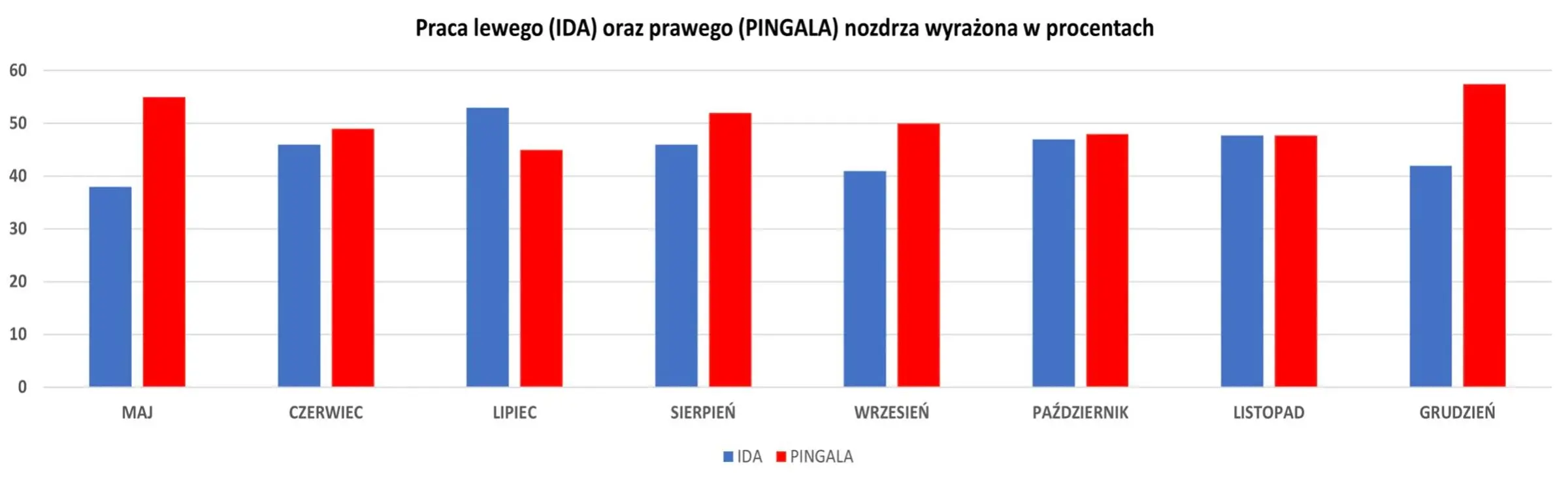
As can be seen in the accompanying diagram, these two energies reached a state of harmony (50%) in October and held that balance until mid-December — though this is not visible in the diagram, since the second half of December saw Pingala win out and reclaim its dominance. This is the result of a conscious tapering-off of the supporting practices of Svara Yoga, ones every yogi knows well: body cleansing, pranayama, and sukshma asanas. Discontinuing these practices very quickly leads to imbalance and a return to the state that existed before October. This does not amount to any great tragedy. As I have already written, throughout the whole period of practice I felt wonderful, both physically and mentally. All it means is that a certain important element quietly disappears (from the magician's pouch) — an element I will say more about shortly. Or rather, it is still there all along — it simply needs to be present in far smaller measure. A bit convoluted, I know! But then, what in life isn't?
And now, the final chord before the Conclusion. And we already know it is better to remain a moment before, rather than after. It is curious how Fulfillment exists more fully in Anticipation than in the moment it is actually meant to reveal itself. After that, there is only emptiness, masked by emotion — and the waiting for the next fulfillment to come. Let us not go down that road. Let us stay in the moment before. If only for a moment.
Nostrils and Action
Let the commentary on this subject be a lengthy quotation from the book “The Power of Life” by Harish Johari, toward whom I hold immense respect, as I do toward the book's translator, Dorota Konieczka, and the entire team at LIMBUS publishing house. Without the work of these people, I do not know whether I would ever have come across the literature devoted to Svara Yoga at all. And as I explained in the introduction, this is one of the most important moments of my life, one that ultimately led to its complete transformation along the path of spiritual search. With the quotation below, I offer my most heartfelt thanks to these people — and it is not without significance that the text below also brings to a close the first part of the land of Svara Yoga, through which I have now been traveling for close to a year, with the deepest sense of wonder and the certainty in my heart that this is the right path.
So let the master step onto the stage now, while you rest a while from my rambling.
Through direct observation, svara yogis discovered the connection between the breath and the effective performance of certain actions. Their findings correspond to the observations of modern neurobiologists, who have discovered that shifts in brain dominance sometimes occur earlier than shifts in nasal dominance. Both ancient and modern scientists confirm: the right side of the body corresponds to the left hemisphere of the brain, and vice versa (…). The breath directly affects the functioning of the peripheral autonomic nervous system. Breathing through the left nostril has a decidedly greater effect on the cortical activity of the right side of the brain than the left, and vice versa. Dr. Khalsa says: “Dominance (…) [right nostril/left hemisphere] corresponds to phases of heightened activity. Left nostril/right hemisphere dominance corresponds to the phase of rest.”
As I have already mentioned, the breath is connected to the mind, whose instrument is the brain. The twin cerebral hemispheres are the tools of the mind, each responsible for highly specialized functions (although some tasks they perform together). This specialization has been called the lateralization of hemispheric function. The localization of these functions — asymmetrical as it is — means the two hemispheres have separate cognitive strategies. And yet the brain functions like a hologram, synthesizing and integrating the reflexes of the senses, thinking, and intuition (perception) into a multidimensional consciousness.
During the dominance of different hemispheres, the very same person will approach the very same situation differently. The nostrils serve as indicators of cortical dominance and can help predict a given person's behavior in a specific situation. If we understand this information and carry out those activities that correspond to whichever hemisphere is currently dominant, we will then make the very best use of our energy.
Effort should be made to undertake activities, whether by day or by night, that correspond to the currently dominant nostril. (…)
Many of the psychological problems of the West stem from the dominance of the left hemisphere of the brain. It is generally believed that people of the Western world are dominated by the left hemisphere, while people from tribal cultures — in India or Africa, for instance — tend to be dominated more by the right hemisphere. So the problem of one hemisphere's dominance exists both in the East and in the West. It is a problem that can easily be resolved by observing the nostrils and periodically regulating them.
The information given in the Table [below], discovered by modern science, was gathered intuitively long ago by tantrikas, who learned to work with the svara ages before. The purpose of Svara Yoga was to teach a person (1) to relax and become aware of their own state before undertaking any activity whatsoever, and (2) to live in constant awareness of both their inner and outer world. A person is often distracted by some thought or idea, and then begins to act on a whim, paying no attention to their present state. By observing the nostrils, and remaining continually aware of which side of the body is more active, a person develops the habit of returning to a state of relaxation. This practice also allows one to decide whether a given action should be carried out immediately, or whether it should wait until the nostrils change. One can also decide to change the active nostril through sheer will.
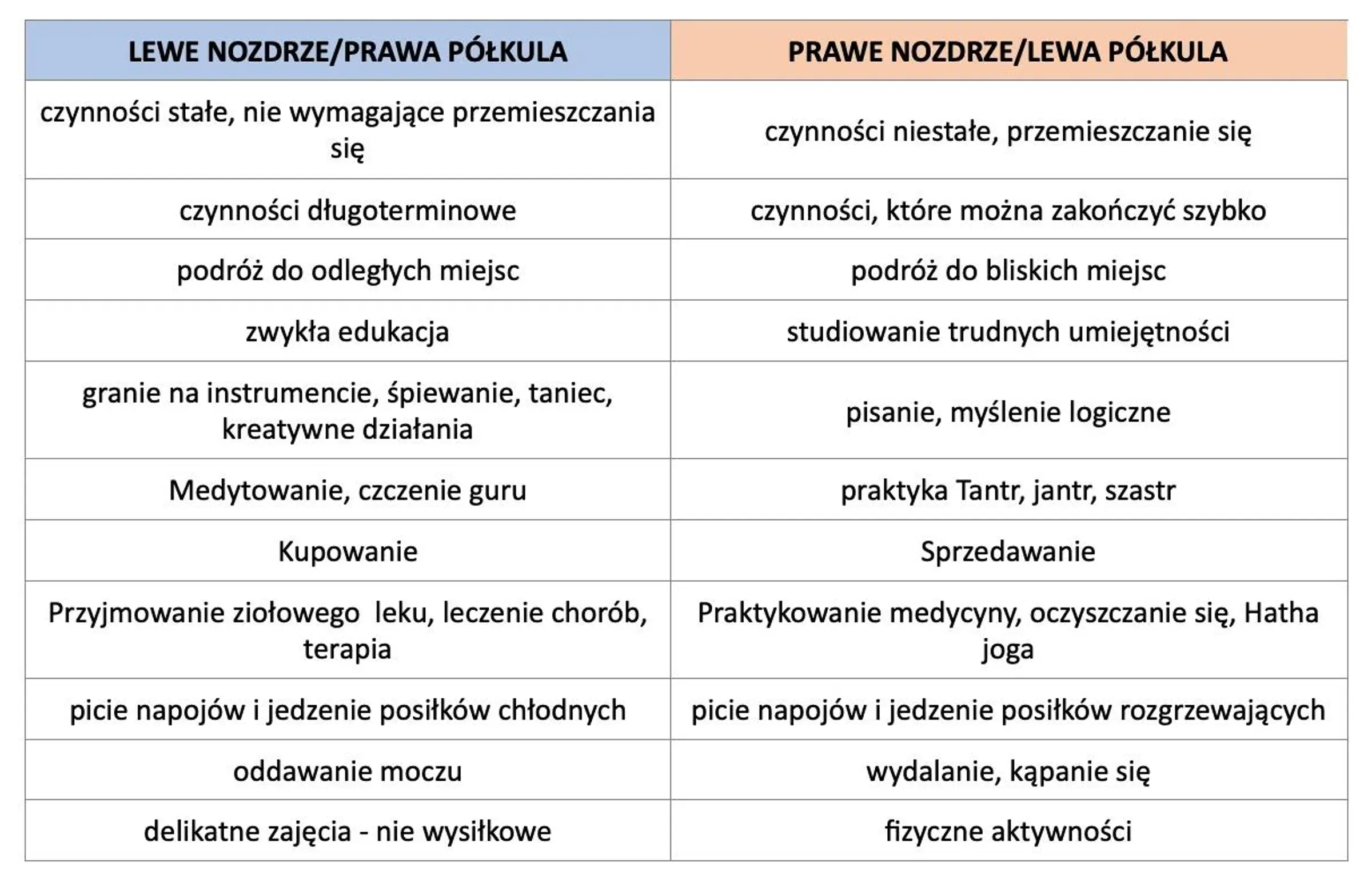
So much from the master — and now, back to the part covering my own experiences with this little table.
Let me take up the example of moving from place to place — a nearby trip versus a distant one. Is traveling within a city near, or far? Or perhaps a journey to a distant city is what counts as far? If nowadays we can travel to other countries, then a trip between two cities in the same country no longer seems so far at all. A trip to, say, India is nothing compared to a flight to the Moon, and a journey to our satellite is nothing compared to the future journey planned to Mars. Physical distance seems to lose all meaning. My practice of Svara Yoga has shown me that it makes far more sense to treat travel in a mental, abstract way. The question becomes: is the place we are traveling to close to us mentally, or distant? Is it entirely new and unknown, or perhaps very familiar to us, yet full of painful memories? It is not nearly as obvious as it might seem, once you actually look at it closely.
The mode of transport we use also matters. It is one thing to travel by car as the driver, or as a passenger in the front seat, when our attention is turned outward and we must think not only for ourselves but for others too; and it is an entirely different situation when we travel as a passenger in a car, train, or plane, handing the controls over to someone else, free to occupy ourselves with activities that do not tax our brain nearly as much as ensuring a safe journey does.
It is one thing to ride a mountain bike, which forces a certain posture on our body and keeps our gaze fixed straight ahead, and quite another to ride a city bike, where our spine stays upright, we move more slowly, and we can take in the views to our left and right at leisure.
These are just a few examples of how varied the interpretation of activities, and their corresponding nostril, can be in today's world. This part of the practice is something each adept of Svara Yoga should develop on their own, observing very carefully the relationship between activities and the nostrils. I, for my part, can only offer suggestions in working through the finer nuances, should the need arise.
Let me add just one more simple exercise, one anyone can perform. While lying on the couch, resting after some intense activity — when the left nostril is active — a thought may cross your mind that you are being lazy, that you have rested quite enough already, since after all there is something to be done, like going out for groceries. At that point, one should stop the stream of thought and listen closely to the nostrils. If the left one is active (as it should be), it means the body still needs rest and recovery. Only once the airflow shifts on its own to the right nostril should one get up and act, since the body itself is now saying: I am ready, let's go and do something.
And now the time has come for closing reflections. Time to describe what happened toward the end of September and continued through the whole of October and November, and into the middle of December of 2023 — the fruit of working with the one-hour cycle. The fruit of attuning to the movements of the Sun, the Moon, and the other celestial bodies.
THE GUNAS
The Music of Prakriti in Three Notes
In music, everything revolves around three anchor points: the root, the third, and the fifth. Likewise in Nature — in Prakriti — the ratio between the three gunas determines the quality, the character, and the diversity of the material and subtle world. Diversity arises when Prakriti passes from its unmanifest state into the state of manifest prakriti, in the form of buddhi (mahat) — intuitive consciousness — after which follows the emergence of the further constituents of the universe, from the subtlest all the way down to the densest: to matter itself.
It is much the same in music. Its character, its diversity, and its beauty emerge once the root, the third, and the fifth are subjected to variation. The root, the third, and the fifth can, of course, be scaled up from a single chord all the way to the entire key of a piece — as I have already mentioned. The smaller within the larger, below and above, and so on — fractals!
My closing reflections compare the gunas to the components of music. There are three gunas: sattva, rajas, and tamas.
Sattva — the root, the very first chord, the strongest and the most distinct of all. Sattva's presence cannot be destroyed, only masked by other intervals. Sattva is virtue and goodness; it is luminous and stays in contact with the soul. Sattva is bliss, an unclouded happiness in simply existing; it is sincerity and love for the whole of creation. Sattva is balance and harmony.
Rajas — the third, which in music has a neutral nature. It can be a major third, in which case its energy flows toward joyful sattva. But it can just as easily be a minor third, whose sadness, sorrow, and melancholy feed tamas, the third component. Rajas is activity, movement, the motivation to act, and the crowning of any activity strengthens it and gives it power. But rajas is also turbulent and unbalanced, and the passion it carries with it heightens the risk of thoughtlessly chasing after desires that can bring pain and suffering.
Tamas — the fifth, the chord that completes and reinforces the entire musical composition. Tamas has one quality that matters enormously to me: the ability to freeze things into form. Tamas is like an icy gravity, holding things fixed in a given state. Tamas strengthens whatever falls within reach of its event horizon. It sucks things in like a black hole, and if what it takes in is ignorance, misunderstanding, pain, and suffering, it forms, out of our sight, a horrifying construct, an illusion that Eckhart Tolle calls the Pain-Body, and which I have named Environmental Tamas.
Nosce te ipsum
Know thyself. This is the maxim carved into the pediment of the Temple of Apollo at Delphi, spoken by many human souls before Socrates, and one that many more will still speak after him. So then, let us come to know ourselves.
I came into this world with a generous share of sattva. How does that show up in a child? Quite simply: in a friendly disposition toward one's surroundings, in avoiding conflict, in a sincere eagerness to learn and to soak up knowledge of the world — which in turn teaches respect and tolerance for other living beings, including our planet Earth itself, on which we are all, after all, traveling together through the vast cosmos. I was never short of sattva in my childhood. I delighted in it, and drew from it everything there was to draw. And there was plenty to do, since the housing block where I spent my childhood stood at the edge of the city, and beyond it lay nothing but fields, woods, and orchards, which in summer filled to the brim with currants, mirabelle plums, apples, and pears, gooseberries and cherries. The forests were close by, and there, a paradise for the imagination: bears, deer, and wolves — pretend ones, of course. We would come home only for a slice of bread spread with butter and sugar, and then off we went again, back out into nature with friends and neighborhood companions. Expeditions and hours spent in reading rooms poring over atlases full of bugs, the architecture of other cities, other countries and lands — books that opened up the mind and prepared it to leap into the future. Beautiful memories.
But… it was not always so idyllic. I also came into contact with darkness, with the dullness and inertia of human consciousness — that is, with stupidity. Yet that had little real effect on me, up to a certain point. But more on that later. For now, let us turn to rajas.
Here a certain difficulty arises. In common understanding, rajas is seen as the guna that is extroverted, showy, one that likes to surround itself with material things and flaunt them, that likes to pressure and impress others, that chases intense sensations, is impulsive, and loves risk. To me, rajas is the chord with a neutral nature. It holds a potentiality that works powerfully together with intention. That is why it is really our intention that determines what rajas will bring us — whether only suffering, or perhaps a path toward sattva. Unfortunately, my own intention, and my own rajas — even though they were never oriented toward accumulating material goods or displaying superiority, but rather toward an intense search for the meaning of my existence in science, philosophy, and art — steered me in the wrong direction. A direction whose nature and consequences I could not see as a child. Nor could I see it as a young man, since the world of the 1990s was an utterly different world from the one we live in now. Now the world fairly boils over with possibilities — perhaps there are even too many of them.
My rajas caused certain pillars of personality to crystallize within me — pillars that, in hindsight, brought me nothing but suffering, or at best a lack of peace and harmony. My belief that knowledge of the world gained through the lens and the naked eye would be enough proved empty. Neither astrophysics, nor philosophy, nor anthropology, and not even taking part in the art of making music, brought me a single millimeter closer to inner harmony and peace. Quite the opposite — that belief built an enormous wall between my intellect and my soul. This kind of learning — let's call it academic — only divides the world into an infinite number of tiny fragments, and does not allow us to experience the world in a holistic, integrated way, one that embraces body, mind, and our spiritual dimension. A science that leaves out the subjective human experience is incomplete, and will forever suffer from its own particular hunger. And I did not want to suffer alongside it. I wanted to break free. And so my path toward self-realization put the rajas I have been discussing into a difficult spot. I decided to change course, and to turn to dust every illusion and every pillar I had built up until then. What comes next… we shall see. Working with this new intention took roughly ten years. But this text is not about that — it is about the chord that crowns this symphony. About what happened toward the end of September, continued through the whole of October and November, and into the middle of December of 2023. But before I get to that, there is still tamas to cover — or rather, environmental tamas.
The most interesting quality of tamas — one that is also enormously important from the standpoint of regaining one's life balance — is its ability to freeze things into form. Freezing into form was my own Achilles' heel. And if a warrior like Achilles himself failed to notice his, then I don't feel too much guilt over not noticing mine either. These constructs, which tamas so eagerly archives within the mind, I have named environmental tamas. Constructs like dark watercolors, gloomy paintings hanging in a museum filled with stolen artifacts of forgotten civilizations.
What is environmental tamas? It is nothing other than Eckhart Tolle's Pain-Body. It is an absorption in darkness, pain, grief, sorrow over unpleasant events, and a failure to understand that suffering is in fact a wonderful gift, carrying within it the very sap of rebirth. It is a lack of faith, uncertainty, delusion, a life lived within a mirage. This happens when the influence of the external environment, and of the events it drags us into, grows strong enough that we succumb to it, failing to recognize our own true power. Tamas binds all of this together, gluing it like gluon glue, and any attempt to break free from this situation only generates a still greater binding energy. For a while this situation can feel like a stalemate, and every moment in which tamas builds its fortress unchecked is a moment that weakens our divine nature — a nature that has always dwelt, still dwells, and will forever dwell within our sattva.
How to Overcome It?
So how does one fight this, how does one break free of this enormous gluon-like binding energy — the same kind of force that, in physics, binds together so-called quarks, and that is no small barrier to overcome? When environmental tamas grows like some kind of cancer, some growth upon the soul, one should… hmm, but wait — who am I to go around proclaiming generalities and arbitrary pronouncements about what “one should” do? I do not know what should be done as a remedy for everyone, some cure-all for every ill. I can only share a fragment of my own path, whose starting point was the practice of meditation — meditation consisting simply of observing thoughts, since it is precisely out of thought that tamas weaves its poisoned cloth. But observation alone is not enough. Thoughts arise out of nothingness, linger a while, and return to nothingness. And that will always be so, because that is the very nature of the mind, and it is what the brain does best of all. What matters is the time during which the thought lingers. That is time for us — time to examine not so much the thought itself, but its emotional context. Put more simply: to cut the emotion away from the thought, so that it does not go on producing further copies of itself and additional emotions. It takes a while, and it is not easy, and there are many other treasures still to be gathered along this path. But this article is not about the whole path — it is about Svara Yoga. And now I will write about that magical ingredient of which we need less.
Blissful State
As it happens, I am a lunar child born into a solar body under the sign of Pisces, which guarantees a certain conflict. I always knew this, and now I have it in the form of numbers and charts. The first months of practicing Svara Yoga always showed a better attunement to the small lunar cycle than to the solar cycle (the great lunar cycle). At the same time, the masculine energy (solar) — called Pingala, that is, the airflow through the right nostril — was more active than the lunar, feminine energy, the airflow through the left nostril, called Ida.
This surplus of masculine energy should come as no surprise. After all, we live in a task-driven environment; we have jobs, children, bills, and dreams of leaving something behind. In such conditions, the airflow through the right nostril dominates, along with the workings of the sympathetic system, responsible for activity, action, and the giving-away of our energy. This outpouring of energy is not, in itself, cause for concern — it is something entirely natural, so long as the guna rajas is functioning properly within us. Its cyclical withdrawal, its periods of inactivity, allow us to recharge our batteries whenever we rest, relax, do something that brings us pleasure, and generally take care to keep our life experience in balance.
The practice of Svara Yoga, that is to say:
The withdrawal of the guna rajas brings the mind to a standstill and leaves it resting in a blissful state of peace and equilibrium. This is not laziness, nor a lack of ambition, even though it may seem that way at first. It is, rather, a state close to what is commonly called enlightenment — though in truth, nothing actually “enlightens” us. It is simply the end of desire, the fading of the guna rajas, and the possibility of observing the spectacle of the remaining gunas: sattva, and a weakening environmental tamas. Later, once environmental tamas has lost its power to act, one can, with the delight of a discoverer, start catching the moments when true tamas tries to seize some energy we no longer need and do what it does best — freeze it solid. But now this mechanism is illuminated by awareness, and it can no longer cause any lasting harm.
Practicing the path of Zen — that is, consciously applying a certain mantra as a response to every thought or event — one day I experienced some highly unusual sensations. That mantra consists of the words: I DON'T KNOW, AND I MOVE ON. And the experience that sprouted from them was an extraordinary bond with the natural world, its almost overflowing vitality, life radiating green light straight into my eyes. It was a kind of witnessing, an observation, as if from outside, of the remarkable spontaneity of life — as if life itself were living on my behalf. It was the sheer delight of information leaving my lips entirely on its own, with no compulsion whatsoever, landing exactly where joy, peace, and fulfillment reside.
Svara Yoga made this spectacle last two and a half months — a time in which I could watch the marvelous workings of sattva upon the construct of tamas, upon environmental tamas. Sattva stripped it entirely of its gloomy coloring, of its musty smell, leaving it faded and drained of strength. All those painful memories, whose force, especially during that autumn period, had always been formidable, became like transparent matter to speeding solar neutrinos. Something that had usually been a barrier now became a mirage, an illusion, a fata morgana easy to see straight through. November is a black gash in my life, a period of terrible memories that have carved deep grooves into spacetime with their sharp claws, forever. Every time, together with the planet, I re-enter this period, the awareness of these wounds becomes acutely, almost tangibly felt. But this time it was different.
This time, environmental tamas became like some trinket in a souvenir shop. I could look at it without any obligation to buy. Memory became what it truly is: a storeroom, mostly full of unneeded junk, dusty pictures from the past. I understood that Memory has every right to exist, and, now and then, to remind us — of lessons that were once painful, but which are now nothing more than signposts for the future, free of any emotions I no longer need.
And so I held a farewell ceremony. Without regret, I paid due tribute to my painful memories, fully accepted their presence, and expressed gratitude that they had existed, that they had stayed with me for so long. Because that is exactly how long they needed to. I looked upon them with tenderness, embraced them with understanding and acceptance, and let them go.
And the weight of the baggage of painful experiences I had been carrying simply vanished. I left it behind in the desert, back where I once lived, in illusion, in a mirage. The rope snapped, and the whole burden of painful experience plunged straight down with the waters of the waterfall, where it will slowly rust away in oblivion. All that darkness turned into a kite held in a child's small hand, somewhere on a beach where that world still exists — the one before the moments that break your heart. Somewhere it took me an enormously long time to reach, because I had stopped believing I was already there.
Life is a symphony written for three gunas. The skillful use of these three chords lets us achieve, within that symphony, the balance we hope for — one with moments of joy, moments of suspension, and moments of sorrow. Let this article be the final chord before I begin writing a new symphony, a better one, full of sattva, whose sound will be so striking that all the Angels will fall from Heaven in wonder.
Bibliography
Enjoyed this article?
Share this knowledge with your family or friends.
Deepen your practice
Related courses in this area of knowledge.
Piyush Mittal
· Founder of the InstituteTeacher of Integral Yoga, expert in traditional Ayurveda, and practitioner of Marma point therapy. For years he has combined authentic, source knowledge from India with a modern understanding of health and human development.


