

Asana is not merely a practice performed by the physical body; it is a practice that engages the body, the mind, and the pranas. Hatha yoga practices are not physical. People consider them physical, but in reality they are not physical — they are pranic. Hatha yoga is not a yoga of physical exercise; it is the yoga of ida and pingala, aimed at restoring the balance of the vital forces of body and mind.
The word hatha yoga points to the focus, purpose, and intention of the practice — balancing the energies of ida and pingala, the vital forces of the body. Hatha yoga can be seen as physical, but yogis see hatha yoga as pranic. This is precisely the difference between the practice of yogis and the practice of ordinary people. Yoga remains physical gymnastics for ordinary people, while yogis can use asanas to change the flow of prana, create a balance of prana, and channel that energy toward other purposes, such as meditation or other activities of life.
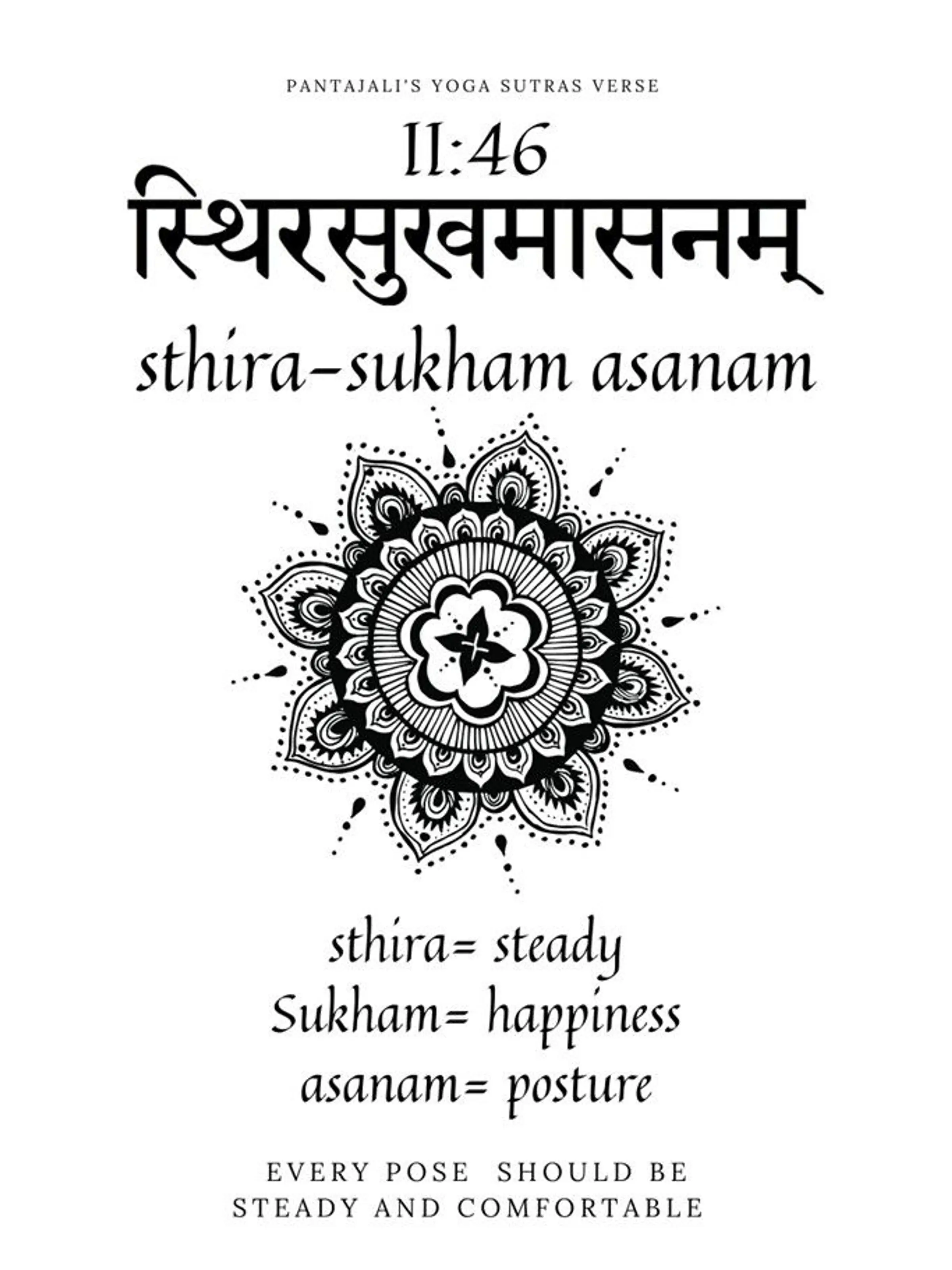
Asana should not be practiced mechanically, without awareness. In every position, try to achieve two things — stability and comfort.
Achieving all of this at once will be difficult. That is why we proceed in stages. First, we prepare the body through SUKSHMA ASANA, so that your joints, muscles, tendons, and so on are loosened and stretched in the way that is right for your body.
But looking more broadly at the question of the body's flexibility — a muscle is useful only when it is flexible. Wherever the body wants 100% rigidity, it produces bone. Wherever it needs 75% rigidity, it produces tendon. Where it wants 50% rigidity, it produces cartilage. Wherever it wants complete flexibility, it produces muscle. The body's structure is made up of different levels of flexibility. If every part of the body were flexible, we would not even be able to sit.
Stiff muscles and a stiff brain are not good. Only when your brain and muscles are flexible are they of any use.
If there is no injury or muscle damage, and the muscles are still tense and stiff, you are probably producing acids in your body. You may notice this: if on a given day you are in a state of mental tension, the next day you will find it much harder to bend. When the level of acid rises, the structure of the muscles becomes stiff.
If you sit joyfully, the body will not produce acids. But if you are angry even for five minutes, the acid level in your blood will rise dramatically, to the point that it actually poisons you, and it is precisely this poison that stiffens the structure of the muscles.
Besides, a lack of flexibility can also be cultural, simply because you are not accustomed to sitting on the floor or using your body in that way. In any case, we cannot judge people by their flexibility. After the practice of Sukshma Asana, you move on to the practice of asana.
Now, when practicing asanas, the first three rounds are done with awareness of the breath. This will loosen up the movements of your body. Do not focus on stability and comfort in the first three rounds. Simply let the body, joints, and muscles open up.
In the next three rounds, focus on physical stillness in the final position. If you are resting on your hands and one knee, you may wobble slightly, but the intention should be to maintain stability. This will develop over time.
Then, in the following three rounds, focus on comfort. Draw your thoughts away from the areas of tension and pain you may experience while performing the asana. Try to feel comfort in the places where you feel stretched or tight. In this way, create comfort throughout the whole body.
When people and yoga teachers practice yoga, they usually say that when you feel tired, you should lie down in shavasana and rest — and this is fine, but only for beginners. It applies to people who treat yoga as exercise.
If you are not jumping from one asana to another in your practice, and you have chosen a few asanas for yourself, then you can move on to the next stage. If we cannot perform ten to fifteen rounds of an asana, we are not practicing yoga. This is a sign of poor physical condition. With every practice, the body becomes fitter and stronger. Endurance and strength will grow within your body.
To do this, you must not perform the asana five times and then lie down in shavasana, but rather ten, eleven, even up to twenty times. Imagine performing Vyaghrasana and Marjariasana twenty-five times. What will the state of your back and spine be after a month of such practice? In the same way, you can work on your other joints or body parts, by choosing individual asanas.
And now you can choose any position to practice — Pranayama, Pratyahara, Dharana, Dhyana, and Samadhi.
Jagadish 'Jaggi' Vasudev — known as Sadhguru — explains what Asana Siddhi is
Yoga is about creating unity between these two dimensions — the inner and the outer, you and the rest, you and the other. When there is no "you" and "other," when there is only "you" and "you," that is yoga. Asanas are the physical form of approaching this ultimate union, because the physical body is the easiest thing to work with.
Asana Siddhi means taking up and perfectly practicing a single asana as the Sadhana of one's life. This is known as Asana Siddhi. Asana Siddhi means being able to sit in a particular way with absolute ease. For most people, however they hold their body, it is never at peace. If you sit, it is not comfortable. If you stand, it is not comfortable. If you lie down, it is not comfortable. If you submit your body to the process of yoga, the body slowly becomes peaceful.
BUT the thinking mind cannot understand how a person could spend an entire lifetime wanting simply to sit in a certain way. Yet everything that can be perceived can be perceived by mastering a single physical posture. What you call yogasanas are simply a geometric fitting of this body to the geometry of the cosmos. If you learn to hold it well, you can draw in the entire cosmos.
This is yoga. If you simply sit well, everything worth knowing can become known to you from within. Patanjali describes asana as "Sthiram, Sukham Asanam" — if you feel comfortable and stable, that is all there is to asana. It simply means that your body is at peace, your mind is at peace, and your energy is fully vibrant and balanced. Now you are naturally meditative. You will discover the full potential of your life.
Yoga is work on oneself to increase the capacity of the physical systems and the pranic system, which is why shavasana should be performed only when you are physically tired — not for the sake of resting, but to rest when the body is tired. Shavasana should be done only between asanas, when the body is tired. If the body is not tired, do not do shavasana; continue the asana practice. This is one of the rules to keep in mind.
Article inspired by the teachings of Sadhguru and Swami Niranjanananda Saraswati
Enjoyed this article?
Share this knowledge with your family or friends.
Deepen your practice
Related courses in this area of knowledge.
Piyush Mittal
· Founder of the InstituteTeacher of Integral Yoga, expert in traditional Ayurveda, and practitioner of Marma point therapy. For years he has combined authentic, source knowledge from India with a modern understanding of health and human development.


